'%3E%3Cpath%20fill='%231B2A47'%20d='M1.605%2016.263c.03-1.139.059-2.482.088-3.971.03-1.49.03-2.832.03-4.03%200-.758%200-1.576-.03-2.51%200-.905-.03-1.84-.03-2.803%200-.496-.028-.964-.028-1.43%200-.468%200-.906-.03-1.315h6.858q2.188%200%203.589.35c.963.234%201.663.643%202.13%201.198.496.555.73%201.372.73%202.394%200%20.788-.176%201.46-.497%201.985-.32.526-.846.935-1.575%201.197-.73.292-1.693.468-2.918.526v.263c1.313.087%202.334.263%203.122.525.758.263%201.342.672%201.692%201.197.35.526.525%201.197.525%202.044%200%201.08-.233%201.927-.67%202.57-.468.642-1.139%201.08-2.102%201.343-.933.262-2.159.408-3.705.408H1.605zm6.537-9.197q1.882%200%202.713-.526c.555-.35.817-.934.817-1.752%200-.905-.292-1.547-.846-1.927s-1.459-.554-2.655-.554H4.757v4.759zm.204%206.92c.934%200%201.663-.088%202.217-.263.555-.176.934-.438%201.197-.818s.38-.876.38-1.518c0-.876-.322-1.49-.934-1.84-.643-.35-1.635-.525-3.035-.525H4.757v4.963zM21.038%2016.555c-1.576%200-2.801-.292-3.618-.905-.817-.614-1.284-1.519-1.372-2.745-.087-1.226.205-2.774.847-4.613s1.43-3.358%202.392-4.584c.963-1.226%202.043-2.131%203.298-2.744C23.839.292%2025.24%200%2026.786%200c1.576%200%202.772.321%203.59.934.816.613%201.283%201.548%201.37%202.774s-.203%202.774-.845%204.613c-.642%201.81-1.43%203.358-2.393%204.584s-2.072%202.132-3.297%202.745a9.8%209.8%200%200%201-4.173.905m.788-2.278c.642%200%201.138-.058%201.371-.116.205-.059.496-.117.847-.322.262-.146.437-.292.554-.408.204-.175.32-.292.438-.41.204-.203.35-.408.496-.583.35-.438.642-.876.963-1.402.233-.408.466-.817.67-1.284.205-.438.38-.905.555-1.372.438-1.198.671-2.278.671-3.183s-.204-1.606-.612-2.131c-.409-.497-1.051-.76-1.897-.76-.467%200-.934.059-1.43.205h-.03c-1.02.292-1.925%201.226-2.042%201.372-.116.117-.467.526-.963%201.343a15.5%2015.5%200%200%200-1.342%202.92c-.408%201.197-.642%202.277-.671%203.182-.03.906.175%201.636.584%202.161q.611.788%201.838.788M14.853%2038.54c-1.576%200-2.802-.292-3.619-.905s-1.284-1.518-1.371-2.744c-.088-1.227.204-2.774.846-4.614s1.43-3.357%202.393-4.584%202.042-2.13%203.297-2.744c1.255-.613%202.655-.905%204.173-.905%201.575%200%202.772.321%203.589.934s1.284%201.548%201.371%202.774c.088%201.226-.204%202.774-.846%204.613-.642%201.81-1.43%203.358-2.393%204.584s-2.072%202.131-3.297%202.745c-1.226.613-2.626.846-4.143.846m.787-2.277c.642%200%201.138-.059%201.372-.117.204-.058.496-.117.846-.321.263-.146.438-.292.554-.409.205-.175.321-.292.438-.409.204-.204.35-.408.496-.584a13%2013%200%200%200%201.634-2.686c.204-.438.38-.905.555-1.372.437-1.197.67-2.277.67-3.182%200-.906-.203-1.606-.612-2.132-.409-.496-1.05-.759-1.897-.759-.467%200-.934.058-1.43.204h-.029c-1.021.292-1.925%201.227-2.042%201.373-.117.116-.467.525-.963%201.343a15.5%2015.5%200%200%200-1.342%202.92c-.409%201.196-.642%202.277-.671%203.182s.175%201.635.583%202.16q.613.789%201.838.789'/%3E%3Cpath%20fill='%23FF515E'%20d='M55.966%2038.57c-1.576%200-2.801-.293-3.618-.906s-1.284-1.518-1.372-2.744c-.087-1.227.204-2.774.846-4.613s1.43-3.358%202.393-4.584c.963-1.227%202.043-2.132%203.297-2.745s2.656-.905%204.173-.905c1.576%200%202.772.321%203.589.934s1.284%201.548%201.371%202.774c.088%201.226-.204%202.774-.846%204.613-.642%201.81-1.43%203.358-2.393%204.584s-2.071%202.131-3.297%202.745c-1.225.613-2.626.846-4.143.846m.788-2.249c.642%200%201.138-.058%201.371-.117.204-.058.496-.116.846-.32.263-.147.438-.293.555-.41a7%207%200%200%200%20.437-.408c.205-.205.35-.41.496-.584a13%2013%200%200%200%201.634-2.686c.205-.438.38-.905.555-1.373.438-1.197.671-2.277.671-3.182s-.204-1.606-.613-2.131c-.408-.497-1.05-.76-1.896-.76-.467%200-.934.059-1.43.205h-.03c-1.02.292-1.925%201.226-2.042%201.372-.117.117-.467.526-.963%201.343a15.5%2015.5%200%200%200-1.342%202.92c-.409%201.197-.642%202.277-.671%203.182s.175%201.635.583%202.16q.614.79%201.839.79'/%3E%3Cpath%20fill='%231B2A47'%20d='M33.06%2016.263c0-.35%200-.935.03-1.81.029-1.051.058-2.103.058-3.154s.03-2.073.03-3.007c0-1.606-.03-3.27-.06-4.993%200-.554-.028-1.08-.028-1.606%200-.525-.03-1.021-.03-1.46h6.828c1.46%200%202.685.117%203.59.38q1.4.394%202.1%201.314.7.963.7%202.628c0%20.992-.174%201.81-.554%202.452-.35.643-.904%201.11-1.604%201.431s-1.576.467-2.627.496v.263q2.058.087%203.064.876c.671.525%201.138%201.372%201.43%202.51.087.41.233%201.023.467%201.84.233.818.408%201.431.554%201.84h-3.414a11%2011%200%200%200-.262-1.022c-.321-1.314-.526-2.19-.584-2.628a5%205%200%200%200-.642-1.46%202.13%202.13%200%200%200-.963-.73c-.408-.146-.934-.233-1.605-.233h-3.326v6.0440000000000005H33.06zm6.332-8.292c1.343%200%202.276-.205%202.86-.613.554-.41.846-1.11.846-2.073%200-.73-.146-1.314-.408-1.723-.263-.409-.671-.7-1.197-.876q-.788-.263-2.1-.263h-3.181v5.519h3.18zM49.4%2016.263l.03-2.745c.029-2.452.029-4.905.029-7.416q0-2.101-.088-5.868h4.085l5.924%2010.335c.087.234.204.438.291.643.117.204.205.408.321.613.38.788.613%201.255.672%201.372h.262c0-.058-.03-.146-.03-.204%200-.059-.028-.117-.028-.175a75%2075%200%200%201-.175-1.314%2010%2010%200%200%201-.088-1.285c0-1.547%200-3.737-.029-6.57V1.84c0-.584-.03-1.11-.03-1.576h2.977c-.03%202.482-.058%205.08-.058%207.766%200%201.694%200%204.438.029%208.292h-4.027l-5.573-9.43c-.875-1.81-1.226-2.511-1.05-2.132-.263-.613-.467-1.08-.613-1.46h-.263c.058.35.117.876.175%201.548.059.7.117%201.168.117%201.46%200%202.978%200%206.306.029%209.985H49.4zM4.698%2038.277c.029-2.627.058-5.255.058-7.883%200-1.576%200-3.503-.029-5.752-1.109%200-2.684%200-4.727.03v-2.453h12.664v2.453c-1.955-.03-3.53-.03-4.756-.03%200%20.584-.03%201.227-.03%201.957s0%201.46-.029%202.218v1.84c0%202.57.03%205.11.059%207.62z'/%3E%3Cpath%20fill='%23FF515E'%20d='M29.441%2038.277c.409-1.05.788-2.102%201.168-3.182s.787-2.16%201.167-3.241c.613-1.693%201.05-2.949%201.342-3.766l1.255-3.65c.116-.38.262-.788.379-1.139.117-.38.263-.73.38-1.05h4.61l-.671%2012.904h.262l8.316-12.905h4.669l-.7%201.869c-.876%202.452-1.343%203.766-1.43%204a501%20501%200%200%200-3.385%2010.16h-2.947c.292-.846.788-2.219%201.459-4.087.175-.526.35-1.08.554-1.606.175-.526.38-1.08.555-1.577.642-1.81%201.342-3.825%202.072-6.014h-.234l-8.724%2013.314h-2.86l.554-13.314h-.175c-.175.496-.38.992-.554%201.489-.175.496-.38%201.022-.555%201.547a163%20163%200%200%200-1.08%203.008c-.145.38-.262.759-.408%201.138-.117.38-.262.73-.408%201.11-.7%201.898-1.284%203.59-1.751%205.05h-2.86zM68.047%2038.277c.175-2.19.32-4.525.467-7.007.058-.905.204-3.912.467-9.051h3.151c-.03.438-.058.934-.088%201.46s-.058%201.08-.087%201.693a264%20264%200%200%201-.409%206.657c-.145%201.986-.35%203.591-.583%204.788h.175Q72.147%2034.892%2073.94%2032a562%20562%200%200%201%204.465-7.066c.32-.496.641-.992.933-1.46s.555-.875.817-1.255h3.268q-.568.832-1.138%201.752c-.408.613-.787%201.255-1.196%201.927-3.88%206.014-6.478%2010.131-7.85%2012.35h-5.193zM79.106%2038.277c.32-.788.758-2.014%201.37-3.65a287%20287%200%200%200%201.577-4.32c.437-1.256.904-2.628%201.4-4.088s.934-2.774%201.313-3.97h11.322l-.846%202.364H87.1l-1.664%204.847%207.645-.088-.612%201.694-7.587-.088-1.75%204.934h8.286l-.846%202.365z'/%3E%3C/g%3E%3Cdefs%3E%3CclipPath%20id='a'%3E%3Cpath%20fill='%23fff'%20d='M0%200h96v40H0z'/%3E%3C/clipPath%3E%3C/defs%3E%3C/svg%3E)
How to Pack Fragile Items: Step-by-Step Protection Guide
Packing fragile stuff is where moves get expensive if you screw it up. Here’s a clear, practical guide you can put on your site that actually protects dishes, glass, electronics, and decor – not just “wrap in bubble wrap and hope.”
1. What Counts as “Fragile”?
All of this should be treated as fragile:
- Glassware, plates, mugs, bowls
- Mirrors and glass tabletops
- Picture frames and artwork
- TVs, computer monitors, electronics
- Ceramics, porcelain, figurines, collectibles
- Lamps and lampshades
- Bottles (wine, liquor, perfumes, oils, etc.)
If something would upset you to see broken, treat it as fragile and pack it with full protection.
2. Packing Materials You Actually Need
Don’t cheap out here; the cost of one broken TV or box of dishes is higher than proper packing.
Boxes
- Double-walled cardboard boxes for very fragile / heavier items
- Dish-pack boxes (thick, tall boxes) for plates, bowls, glasses
- Small and medium boxes (NO huge boxes for fragile items)
Padding and wrapping
- Bubble wrap (small bubbles for glasses, large bubbles for electronics/decor)
- Packing paper (ink-free, not newspaper for anything expensive or porous)
- Foam sleeves or pouches (for plates, glasses if available)
- Foam corners (for TVs, mirrors, framed art)
Void fill
- Crumpled packing paper
- Packing peanuts or air pillows (better for lightweight items, not heavy ones)
Other
- Strong packing tape (at least 2″ wide)
- “FRAGILE”, “THIS SIDE UP” labels or marker
- Stretch wrap for bundling and securing parts
- Zip-lock bags for screws, hardware, cables
3. Core Rules for Packing Fragile Items
Before the specific items, remember these rules:
- Heavy at the bottom, light at the top.
- No empty space inside the box. If you shake the box and feel movement – it’s wrong.
- One category per box if possible. Don’t mix tools, books, and glasses in one box.
- Small & medium boxes only. Large boxes = crushed items.
- Always pad the bottom, sides, and top. The item never touches bare cardboard.
4. Step-by-Step: General Packing Method
Use this method for most fragile items; then see specific sections for fine-tuning.
Step 1: Prepare your packing station
- Clear a table or countertop.
- Lay a blanket/towel or stack of packing paper on the surface.
- Have tape, paper, bubble wrap, and boxes within reach.
Step 2: Build and reinforce the box
- Assemble the box and tape the bottom with at least two strips of tape across the seam.
- For heavy fragile items, add an extra strip across the middle in the opposite direction (H-shape).
- Line the bottom with a thick layer of crumpled paper or bubble wrap (2–3 inches).
Step 3: Wrap each item individually
- Start with one piece at a time.
- For packing paper:
- Place item in the middle of 2–3 sheets.
- Fold corners of the paper over the item, rolling it until fully covered.
- For bubble wrap:
- Wrap the item completely, bubbles facing inward, secure with tape.
- Very fragile items get paper + bubble wrap.
Step 4: Place items in the box correctly
- Always put heavier items at the bottom, lighter on top.
- Stand plates and lids vertically, like records, never flat in stacks.
- Keep at least 1–2 inches of padding between items and box walls.
Step 5: Fill gaps
- Use crumpled paper to fill any spaces between objects.
- The goal: when you close the box and gently shake it, nothing moves.
Step 6: Pad the top and seal
- Add a last layer of paper or bubble on top of everything.
- Close the flaps, tape securely (again, at least two strips).
Step 7: Label clearly
- Write on the top and at least one side:
- “FRAGILE”
- Room name (Kitchen, Living Room, etc.)
- Short contents (“Glasses”, “Plates & Bowls”, “TV”)
- “THIS SIDE UP” if orientation matters
5. How to Pack Specific Fragile Items
5.1 Plates & Bowls
Best box: Dish-pack or small/medium box.
- Place a thick layer of crumpled paper at the bottom.
- Wrap each plate individually in paper or foam sleeve; for expensive sets, add bubble wrap.
- Stand plates vertically in the box; they handle pressure better.
- Bowls: nest 2–3 bowls together with paper between them, then wrap the stack.
- Fill all gaps with paper, pad the top, seal and label.
5.2 Glasses & Stemware
Best box: Dish-pack with cell dividers if possible.
- Put crumpled paper at the bottom.
- Stuff the inside of each glass with paper.
- Wrap the glass with 2–3 sheets of paper, then a layer of bubble wrap for thin/expensive ones.
- Place upright in cells or tight rows.
- Fill spaces between glasses and at the top with paper; nothing should move.
5.3 Mugs
- Similar to glasses but less delicate.
- Stuff inside with paper, wrap once or twice, and place upright.
- Don’t overload the box – mugs get heavy fast.
5.4 Vases & Odd-Shaped Glass Items
- Fill the inside with crumpled paper or foam.
- Wrap the entire vase with bubble wrap, focusing on the neck.
- Stand upright in a small box with a snug fit.
- Surround with paper or peanuts.
- Label “FRAGILE – VASE – THIS SIDE UP” clearly.
5.5 Electronics (Computers, Consoles, Small Devices)
Best: Original box with foam inserts. If not available:
- Back up important data before packing.
- Remove cables and accessories; put them in labeled zip-lock bags.
- Wrap the device in anti-static bubble (if possible) or regular bubble wrap.
- Place in a box lined with foam or thick padding.
- Fill all sides with padding so the device can’t move.
- Mark “FRAGILE – ELECTRONICS – KEEP UPRIGHT”.
Tip: Electronics should not go into an unheated/uncooled storage unit in extreme temperatures if you can avoid it.
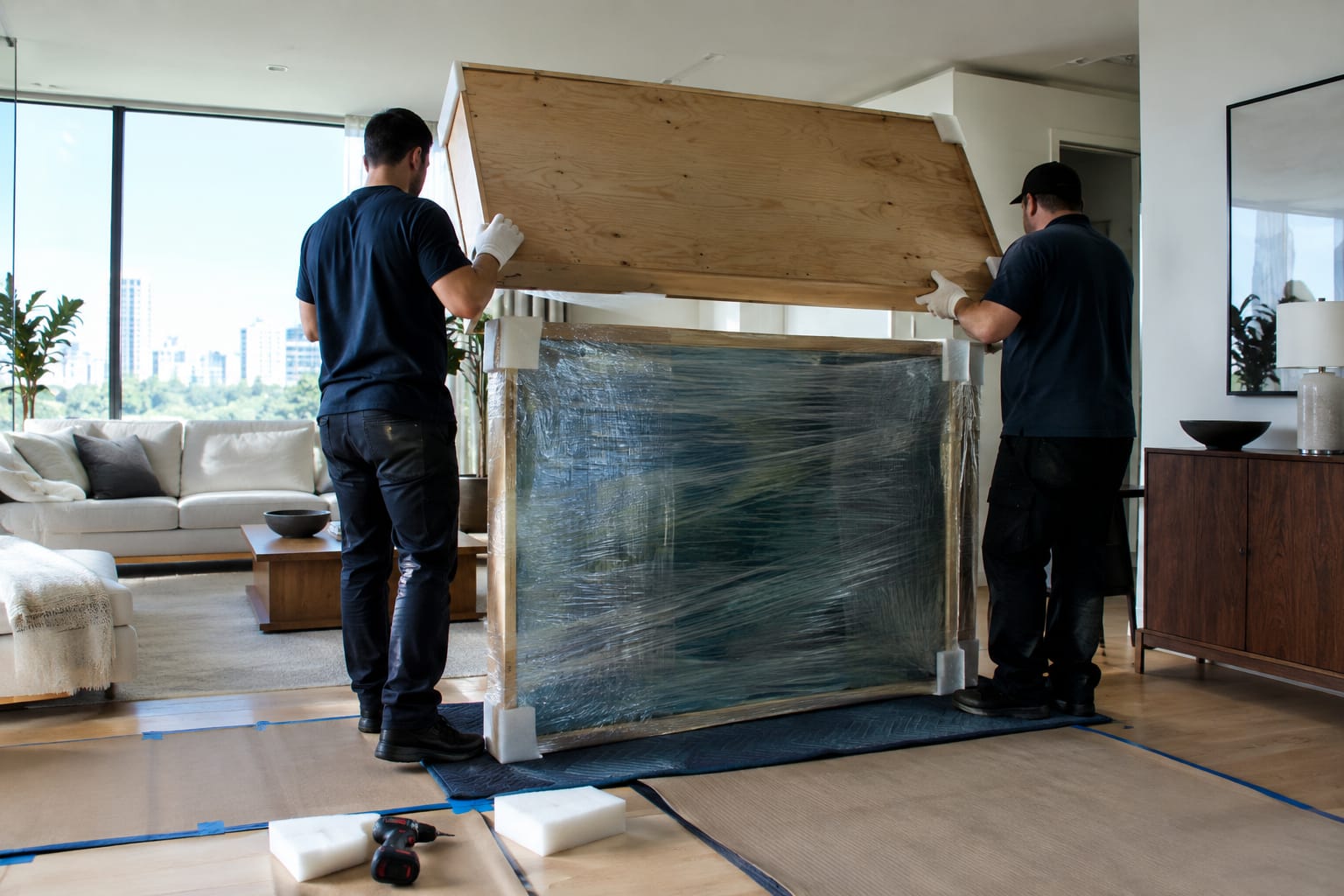
5.6 TVs & Monitors
Ideal: Original box. If not, use a TV/mirror box.
- Remove the TV stand and pack screw/parts in labeled bag tapped to the box.
- Cover the screen with a clean microfiber cloth or thin foam sheet.
- Add foam corners to protect the edges.
- Wrap the entire TV in bubble wrap.
- Slide into TV box; fill gaps with foam or padding.
- Mark “FRAGILE – TV – DO NOT LAY FLAT”.
5.7 Mirrors, Glass Tabletops & Framed Artwork
- Tape a large X across the glass with painter’s tape (helps hold shards if it cracks).
- Protect corners with foam or cardboard corner protectors.
- Wrap the entire piece in bubble wrap.
- Place in a mirror/art box or create a sandwich:
- Cardboard sheet – wrapped item – cardboard sheet.
- Pack upright in the box, never flat.
- Fill gaps and label: “FRAGILE – GLASS – DO NOT LAY FLAT”.
5.8 Lamps & Lampshades
Always pack base and shade separately.
Lamp base
- Remove the bulb and harp (metal piece).
- Wrap base with bubble wrap; secure with tape.
- Pack upright in a small/medium box with padding.
Lampshade
- Do not bend or crush.
- Wrap in clean paper (no ink).
- Place in a box slightly larger than the shade; fill around with light paper.
- Mark “LAMP SHADE – DO NOT CRUSH”.
5.9 Collectibles, Figurines, Antiques
- Wrap small parts first, then the entire piece.
- Use extra bubble wrap and double box if very valuable:
- Item wrapped and packed in a small box with padding.
- That box placed inside a bigger box with more padding around it.
6. What NOT to Do (Common Mistakes)
Avoid these if you don’t want to open a box of trash at the new place:
- Using huge boxes for fragile items – they get way too heavy and things shift/crush.
- Leaving empty space inside boxes – movement = damage.
- Stacking plates flat in piles – they break much easier from pressure.
- Using only newspaper for expensive or porous items – ink can stain.
- Mixing heavy and delicate in the same box (books with glasses, tools with decor).
- Skipping labels – if the box doesn’t say “FRAGILE”, don’t expect careful handling.
- Cheap, thin tape – boxes open during the move, especially on stairs.
7. Working With Movers (If You’re Hiring a Company)
If this is for your company site, this section is useful for setting expectations:
- Ask about valuation/coverage. Basic coverage is usually very low by default; customers should know that.
- Clarify who packs what.
- If the customer packs fragile items themselves and they break, companies often aren’t liable.
- If movers pack them, they can usually offer better coverage.
- Label boxes so movers know what to handle with extra care.
- Separate extremely valuable/irreplaceable items:
- Jewelry, cash
- Important documents, passports, deeds
- Hard drives with critical data
These should travel personally with the customer, not in the moving truck.
8. Quick Checklist: Packing Fragile Items
You can put this as a box/infographic on the page.
Before packing
- Bought enough small/medium and dish-pack boxes
- Have packing paper, bubble wrap, tape, markers
- Cleared a table or counter as a packing station
While packing
- Every item wrapped individually
- Bottom of each box padded
- Heavy items at the bottom, light at the top
- No empty space inside any box
- Boxes not overloaded (can be lifted safely)
After packing
- Top of each box padded before closing
- All boxes taped securely
- Each box labeled with: FRAGILE + room + contents
- Extremely valuable & personal items separated to travel with you